
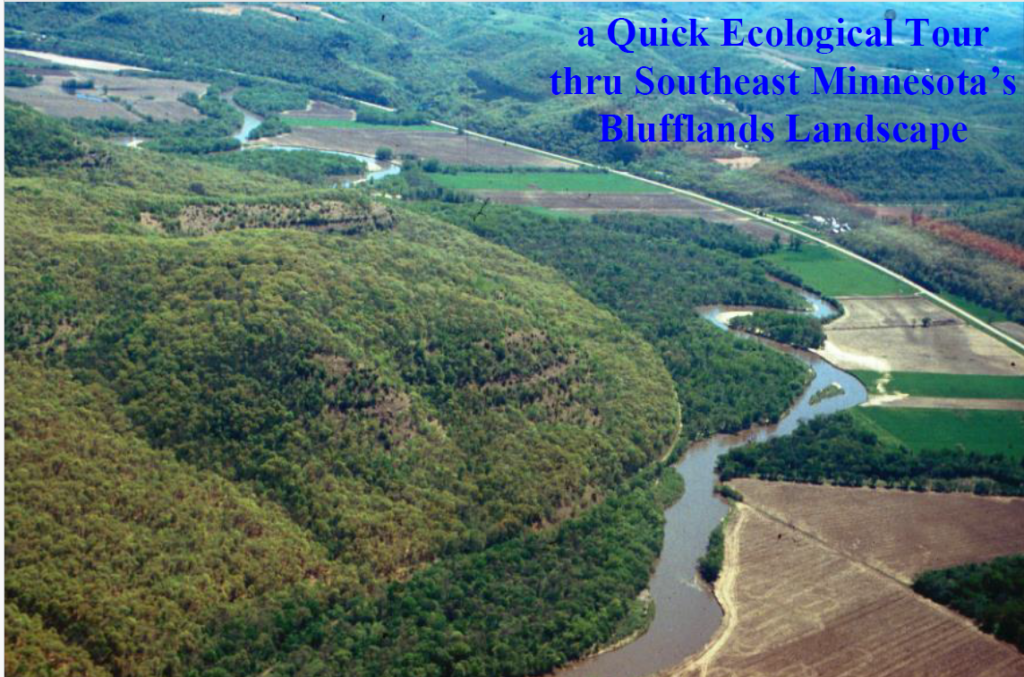
At our meeting on February 18th, Mike Lee, botanical research scientist with the Minnesota Biological Survey (MBS), shared information about his research in the driftless area of southeastern MN. Mike was part of a team that collected data on plant and animal distribution in this area starting in the 1990’s. They were also looking for areas with high biodiversity and for rare plant and animal species. The presentation focused on Winona County and the Winona area, but it applies much more broadly than that, largely to the driftless area in southeastern MN. The driftless area is a term used to describe the region that is part of four states that was not under ice during the last glaciation. Mike described the blufflands as a tabletop that’s been incised by water from retreating glaciers. He pointed out that the Mississippi River is the backbone of the region, as well as all the drainages that flow into it.
Mike explained that the Ecological Classification System (ECS) is a way the DNR and other agencies organize different parts of the state based on similarities. In Minnesota, the highest level includes the Laurentian Mixed Forest, Eastern Broadleaf Forest, and Prairie Parkland. There is also a small area of Aspen Parkland, which is prairie with a lot of Aspen in it. In southeastern MN, the next division down is the Paleozoic Plateau, which is further divided into the hilly terrain of the blufflands, and parts of the plateau that weren’t carved out, which is the Rochester Plateau. The presentation was focused on the blufflands.
Mike noted that topography defines this area, and our image of the blufflands as steep slope country. That’s a big reason why it’s so important for biodiversity today: it was too steep to plow. The carving of the plateau has left behind many ecosystems, including Mesic Prairie, and Mesic Oak Savanna on the ridge tops; Dry-mesic and Mesic Oak Forest, Dry-mesic Oak Woodland, White Pine Forest, Algific Talus Slope and Maderate Cliff (both are unique safe havens for boreal species), Shady Mesic Moist Cliffs, Dry Cliffs, and Bedrock Bluff Prairie on the slopes, Sugar Maple-Basswood Forest on the Narrow Bottomlands; Dry Sand Prairie on the Terraces and Dune Fields, Black Oak and Jack Pine Barrens on the Terraces, and Springs and Seeps, Seepage Swamps, Seepage Meadows and Fens, Floodplain Forest, Riverbanks, Emergent and Floating-Leaved Marsh, and the Mississippi River on the Bottomlands. Mike pointed out rare species found in these ecosystems.
Lastly, Mike explained threats to this biodiverse area, as well as positive steps being taken to preserve it. Thanks, Mike for displaying a biodiverse region of our ecologically diverse state.