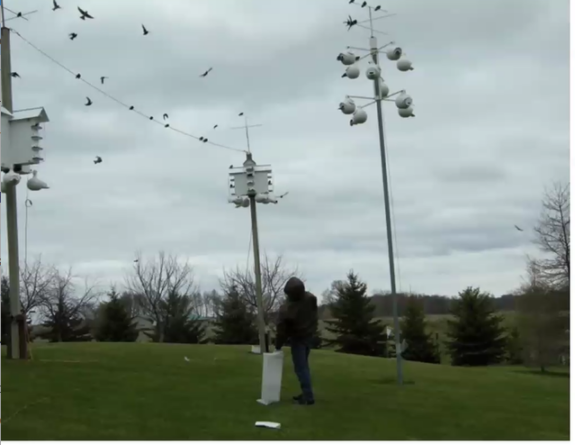
Dick Doll is a Stearns County resident with a love for purple martins. He shared his experiences at our March meeting. Dick began working toward purple martin conservation in 2002 in Willmar. He is now involved in a geo-locator study of purple martin migration being conducted by Texas A&M, Columbia University of Manitoba, and the University of Bemidji. Purple martins migrate to the Amazon River basin in South America for the winter, where they are dealing with mercury-polluted rivers. When banding birds, Dick noted that they measure the wings and tail, collect blood, and put the geo-locator on the bird. They will have to re-collect the geo-locator to get the information. To date, they have been able to say that purple martins can live to be at least 10 years old…maybe older.
Goals for banding birds are to study fidelity to colonies, determine survival and productivity, as well as dispersal from colonies. Dick noted that people need to be licensed to band birds. Dick bands under the guidance and licensure of Michael North. He uses a spotting scope to read the bands on the birds’ legs.
When staging for migration, purple martins roost in large communal groups… large enough that they can be picked up by Doppler radar! Large communal roosts have been seen near Big Swan Lake (near Grey Eagle) and Upper Spunk Lake (near Avon).
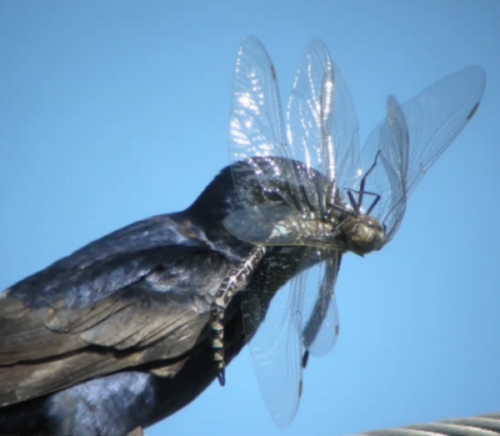
Dick noted that purple martins like big rooms for their nesting. If they have large rooms, they will have bigger clutches. He described where to site purple martin houses, as well as the best designs for houses and poles. Dick explained how to maintain purple martin houses. He noted that purple martins do not eat mosquitoes in quantity; they feed mosquitoes (or fire ants) to their very new babies. Parents quickly move to feeding their young bigger bugs including but not limited to butterflies, damselflies, and dragonflies.
Challenges to purple martin colonies include weather (cold, windy weather that affects insect availability), predators (primarily Cooper’s Hawks, raccoons, and owls), and nesting site competition (with starlings and English sparrows). If you put up a purple martin house, please consider managing the starling and English sparrows (they’re not protected like all other migratory birds) and put a baffle on the pole to keep raccoons away.
Dick offered to take people out band reading at any time during the entire month of August. He can be reached at (320) 894-4095. His address is 8104 245th Street, St. Cloud, MN.